Friday, 4 May 2012

HARM - The Kindle Free Promo Update

Successful Promo

The promo is now over.  Managed to give away just over 300 copies! 


Grab your copy today from Amazon.com or for your local country version of it if they support ebooks.
http://www.amazon.com/dp/B007X65FYA

May 6
Last day for the free promo. Giving away stuff is truly hard.  Sales are tapering off and I do suspect that not being categorized in SF hurt the longer term for cross-sales where a buyer buys one sci fi book and is shown a list of other books that were bought in conjunction (basically Amazon word of mouth).  Still, the book is ranked #33 in Science Fiction Adventure, #75 in Science Fiction with a free rank of 1696.  

May 5
It's 10 AM and the day is starting well.  The problem with the missing science fiction category has mysteriously resolved itself - customer support hasn't contacted me yet, but I'm still way happier than before.  It just might take 24 to 36 hours for the system to recategorize the book.  I'd still like to get a couple of promo days back (you only have 5 every 4 months and part of Kindle Select).  HARM is now #28 in SF and rising through the ranks again to 1380. My thanks to anyone who helped out yesterday.


May 4
Things are not so happy today.  Tried to correct that category problem where my book wasn't listing under science fiction and it isn't fixing itself.  I'm probably losing half of my target audience from internal traffic within Amazon itself as science fiction fans are not seeing it.  So if you know anyone who likes science fiction and mechas, please let them know about this. I'm contacting Amazon support to see if they can fix it.

May 3

I'm happy to report that I'm managing to give it out to readers to kick start it.
It started in the Amazon free sales ranks at 6567 this morning and it is now at 1387.
Only problem is that I've found that the category science fiction / military doesn't seem to show up under science fiction and I'm probably losing a lot of SF readers checking the Amazon free lists. But it is #5 in War. 
I've had some eager readers and I'm glad they're liking it. I got one awesome review!
I'll keep this post updated for the duration of the promo.

Tuesday, 24 April 2012

HARM - A Story From The World Of Exocrisis Blue

HARM
Visualizing intense mech vs. mech combat with near future and alien technology!

In HARM, mankind is fighting a desperate action to keep the invading aliens at bay and to keep from being exterminated.  HARM is set in the future world of Exocrisis Blue where the Alien War is well underway.  The nations of Earth have been ravaged by unrelenting combat with the Blue Newts.

This stand-alone story (approximately 9400 words or 30+ pages) is all about future robotic warfare with intense mech verses mech battles.  The story introduces several continuing characters and the background for Exocrisis Blue during the Alien War.  All the weapons of the near future battlefield are utilized from autonomous battlefield robots, main battle tanks, powered infantry in exoskeleton battlesuits to unmanned drones. HARM is about the first combat use of a giant, humanoid robot, fighting machines against the invaders.  Can these new humanoid weapons turn the tide of the war?

HARM = Humanoid Assault Reconnaissance Machine

Exocrisis Blue
Exocrisis Blue occurs sixteen years after the end of the Alien War.  By the end of the year long Alien War, many of the old governments of Earth had collapsed and a radically new set of nations had emerged.  In this new world man shares the Earth with the alien Blue Newts in an uneasy truce.  Nations, cities, and people have rebuilt their infrastructure and lives.  For a new generation, the Alien War is no longer immediate, it is something in the past.

At the General Automata Corporation Development Institute a new generation of HARMs has been created.  To pilot these more advanced machines, youthful HARM pilots are needed to maximize the potential between the new neural interfaces.  The military training facilities at the institute selects and trains the best of the best with experienced instructors and training techniques.  However, deep inside the institute is the much more secretive “AO Sensor Facility."  Events are in motion and the fate of the world hinges on the actions of a few.
 

Monday, 19 March 2012

Conversations With Intelligent Weapons

I'm currently working on some new writing / world building projects that combine hard SF and anime mechas.  Needless to say there will be robot battles, a mecha training academy, and some teen angst, but the adults will carry the day.  My mechas are not big like the Mazinger or Gundam in height (60 - 70 feet), but maybe 40 - 50 feet high.  They can hide behind a two story building, be nimble, yet well armoured and pack a big punch.  If you do watch anime, the closest thing would probably be the M9 Gernsbacks or the ARX-7 Arbalest from Full Metal Panic.  The mechs can't be too big a target and need good defences as they have to be able to survive in an environment full of cheap anti-tank missiles and rockets.
ARX-7 with Shotcannon   / Peter Lok
Human pilots would operate the mechas (as in who wouldn't want to drive one of these bad boys), but there would be extensive automation with AI to help run the thing.  As these mechas are fighting on next generation battlefield with computers everywhere I'm going to have to take into account robot swarming tactics, UAVs, fully autonomous battle field robots, and issues with advanced AI.

Artificial Intelligence
AI of some form is going to play a big role both as a decision support system and to actually assist in operating my mechas.  I'm pretty sure I'm not going to deal with rogue AI's as I don't want to deal with this trope: "Whenever an Artificial Intelligence (A.I.) is introduced in a story, there is a very good chance that it will, for whatever reason, become evil and attempt to Turn Against Its Masters, Crush Kill Destroy All Humans, and/or Take Over the World. It doesn't matter what safeguards its creators install — the moment it crosses the line into sapience, it has a strong chance of going rogue at some point." From all AIs are a Crapshoot - TVTropes.org

I think I'd rather have AIs that only assist humans or work at a human master's direct order.  If they are really smart, then they would take on personas and "a human-like life of their own."  The AIs would be able to have deep conversations, identify most human emotional states, but not get upset or emotional themselves. For any fully autonomous bots they would hopefully they obey Isaac Asimov's Three Laws of Robotics!
  1. A robot may not injure a human being or, through inaction, allow a human being to come to harm.
  2. A robot must obey the orders given to it by human beings, except where such orders would conflict with the First Law.
  3. A robot must protect its own existence as long as such protection does not conflict with the First or Second Laws.
Any robots on the battlefield, especially with fully autonomous battlefield robots, you have the Kill Chain in which a human should be involved.  "The Kill Chain consists of 6 "links"; Find, Fix, Track, Target, Engage and Assess, (FFTTEA). To put it in more detail, it is the ability to locate, discern, and track targets and to employ the best weapons available to achieve the desired lethal effects; then to assess results and to reengage speedily as required."  If the AI were faulty you could override, otherwise it is kind of late. Friendly fire is an issue with automated weapons as they cannot tell friend from foe, but if you didn't care and just wanted an area wiped out, then I guess you would just deploy your killbots!

To round this out I thought I would mention some movies with bad AIs and their conversational skills! All of these movies have some chit-chat with the AI over good and bad, etc. Myself, I don't think I'd ever do a scene where you have someone begging a robot for their life and showing them pictures of their wife and kids.

M5 - Ultimate Computer episode from Star Trek.
An experimental computer is installed on the Enterprise and it goes amok during war games and damages other Federation starships.  Kirk must convince the M5 computer running his ship that is has erred and then save his ship after the computer suffers from remorse... Some pretty cool clips on Youtube about this episode.  There was also V'ger and Nomad too, but M5 was the best.

Dark Star
Dark Star is a 1974 science fiction dark comedy directed by John Carpenter (of The Thing fame).
"In the middle of the 22nd century, humankind has reached a point in its technological advancement to enable colonization of the far reaches of the universe. Armed with artificially intelligent "Thermostellar Triggering Devices", the scout ship Dark Star and its crew have been in space alone for twenty years on a mission to destroy "unstable planets" which might threaten future colonization."  From Wikipedia.

I only ever saw this movie once a long time ago, but I still remember the scene about Lt. Doolittle having to talk down a "smart bomb" that was accidentally activated.

Terminator 2
John Conner develops a bond with the T-800 terminator robot sent to protect it and teaches it that killing is bad.  They even develop a father-son type relationship. Even Sarah Conner looks to the future with renewed hope, as a Terminator can learn the value of human life.

Aliens
Bishop the synthetic organism on the crew doesn't go rogue! Go figure!?!  In fact, he/it goes and volunteers for a dangerous mission even though it doesn't want to as there are aliens running all over the place.  I'll take a Bishop anyday.

The Iron Giant
Big galactic battle robot learns that killing is bad and death is permanent from a young boy. If you missed this animated feature that was a box office flop, but now a classic, it is well worth a watch.

Stealth
The United States Navy has built three new top-of-the-range fighter jets called F/A-37 Talons. Three elite pilots are chosen to fly them.  The pilots are introduced to an autonomous UCAV piloted by an artificial intelligence "EDI" (Extreme Deep Invader). Anyhow, EDI gets hit by lightning, become really smart with a skewed moral compass and goes rogue.  At the end, EDI is convinced by the lead pilot to be good again to help finish out the movie!  It was cliched and dumb in parts, but I enjoyed it anyhow.

Tuesday, 6 March 2012

Tales From A Yellow Star Published

My collection of short stories went live on the Amazon Kindle Store today. Hurrah!!!

http://www.amazon.com/Tales-Yellow-Star-ebook/dp/B007HHQGKM/ref=sr_1_2?ie=UTF8&qid=1331090798&sr=8-2

The four short stories about space exploration set in the near future to the far future.  It is approximately 90 pages long between all of the stories.
  • Orbital Decay: The crew of a space station is left to their own devices after a global catastrophe.
  • Guardian of Life: A war machine left over from an ancient conflict.
  • Pattern From The Past: It was a new planetary colony with an old problem.
  • Shaman: Ancient ritual and technology combine on an alien world.

The cover above was the second cover design I worked on that incorporated the more dynamic text swoosh and the colorful space colony.  This was much nicer than the first cover design shown below with a black and white solar power satellite (also courtesy of NASA).


Saturday, 11 February 2012

BigDog - Robot Pack Mule

It looks like there's going to be robots packing gear for our infantry in the field, although the application wouldn't be purely military.  Robotic supply trains must be on the horizon if this works out.  Big Dog is an all-terrain 4 legged robot that was inspired by an engineer's dog (way better than the wheeled rover thingy from SG-1).  This robot is loud due to the gas motor running in the prototypes, but it has pretty good terrain navigation abilities.  The AI and mechanics of this machine are pretty amazing.


http://www.bostondynamics.com/robot_bigdog.html

BigDog can do the following:
  • runs at 4 mph
  • can walk through mud, snow, water, and ice
  • can climb slopes up to 35 degrees
  • can move through rubble
  • carries a 340 lb load. 
It also traveled 12.8 miles without stopping or refueling.  This machine is pretty amazing and was developed under the DARPA umbrella as the Legged Squad Support System. Created under DARPA's Big Dog Technology and called the LS3 (or Lassie).  The current version is ready to receive voice command programming with instructions like "sit," "stop," or "come here." Normally, there is a remote used to operate it. BigDog is now in its final 18-month development cycle with Army and Marine field trials last. 
In some of the video I was really impressed by how it recovered its balance after being kicked to the side.


Saturday, 4 February 2012

A Second War of the Worlds - A Battlefield Vignette


Please stand by.  This is the Emergency Broadcast System. The Federal Government has declared a state of emergency and has invoked the War Measures Act. Martial law is in effect.  Please do not panic and await further instructions for your locality.  The Prime Minister will address nation at 5 PM eastern standard time, 3 PM mountain standard time.  This station will keep you posted as to any further news as soon as it becomes available...

Please stand by.  This is the Emergency Broadcast System.  The Federal Government has declared a state of emergency...

Flickr / Morning Calm News
The Martian war machines came striding south over the hill.  For their huge size, they were strangely quiet.  One would have imagined loud thumping noises as they walked, but they only made a slight whine as their tall spider-like legs fluidly moved.  At first, only two machines were visible, then two more appeared over the rise.  There were just four machines, but four identical machines had already mauled the Canadian First Mechanized Brigade that had opposed them first. 

Captain Kale thought it was odd he wasn't scared as he observed the alien machines moving towards his fighting positions.  His first time in actual combat and it wasn't even against a foe the U.S. Army had ever prepared for.  For a moment he was enthralled by the sight of the 100 foot tall war machines.  The photos he had seen at the intelligence briefing had not completely prepared him.

They had six spider-like legs, and walked - or was it a scuttle - forward two pairs of legs at a time.  The central body was like a flattened egg, a rounded tear drop, that had the narrow end forward.  On top of the body was a thick stubby pillar that contained sensors and the terrifying beam weapon that burned through steel plate like it a blowtorch through a tin sheet.  This was the enemy and he had to stop it.

Kale took his eyes off the distant war machines and looked to his left and right.  He could see both neighbouring tanks were already buttoned up, with only the turrets visible over the hill.  However, they were both well camouflaged and he only spotted them as he knew where they were.  His company of M1A2 Abrams tanks were the core of the first line of defence against these southward moving Martians.  He couldn't see the rest of his mechanized battalion, but he knew additional tanks and TOW armed Bradley IFVs were well camouflaged around them. 

Just a week before they had been on maneuvers with the Canadian Armed Forces at Wainwright, and now they were dug in, hull down, along a low ridgeline overlooking a creek and the Number 2 Highway.  The Martians would be facing an impressive amount of firepower waiting in ambush.  The sound of distant helicopter rotors reached his ears and he knew the Apache gunships were maneuvering into position.  The show was about to start and he had a front row seat.  He dropped down into the turret and shut the hatch behind him, buttoning up his tank.  Looking through the commander's sight, he set the magnification to 4x on the lead war machine and designated it as the target to the gunner.  "Sabot!" he shouted into the mike.

"Up!" replied the loader, as he loaded the armour piercing round into the cannon.

The laser rangefinder showed 2100 metres and closing. The aliens were well within range.  The 120 mm gun had a 90% chance of scoring a kill on an enemy tank at 2000 metres.  Still, he held his fire.  The gunships were to initiate combat and the tanks were to fire immediately afterwards.

Somewhere behind him, several spotting helicopters, edged themselves up above the treeline.  Only a bulbous extension at the top of a mast above the main rotor for each Kiowa was visible to the enemy as they did this.  With all the sensors and laser designator in the bulb, it was not necessary to expose the entire helicopter.  Spaced out well around the Kiowa, the Apache gunships hovered like impatient wasps.  Cued by their spotting helicopters, the Apaches did a brief popup above the trees to ripple off a pair of Hellfire missiles, 5 seconds apart, then descended back down to maneuver into new firing positions.  Each of the war machines had been illuminated by the laser designator of a spotting chopper and the Hellfires homed in on their targets.  The barrage of Hellfire smoke trails was the visible to everyone.

Suddenly the order to fire crackled over the battalion radio net.  "Fire!" Kale repeated to his company.

There was a sharp crack and the tank vibrated as the main gun fired. "On the way!" shouted the gunner.  All along the ridge, the 14 tanks of his company opened fire into their designated kill zones.

As the cannon breach moved forward, the loader was already in motion to open the breach, and load a new round into the gun.  They could get off 6 rounds per minute this way.

Explosions began to erupt all over the body of the Martian war machines.  Hellfires struck the bodies of the war machines dead on target. Each Hellfire had high explosive shaped charge for a warhead.  When they exploded the blast was concentrated into a single point where it would vapourize steel plate, turning it into a supersonic jet of plasma that could burn its way through nearly a yard of steel. 

The war machines were staggered by the blasts, their legs stopped moving forward and were still.  Seconds later, still shrouded in blackish smoke, the armour piercing shells from the 120mm guns on the tanks struck home.  Each round was a sharpened rod of depleted uranium, one of the densest materials produced by man.  Unlike the Hellfires, these shells punched right through armour with the sheer kinetic energy of a heavy projectile travelling over 1200 meters per second.  Capable of punching through nearly a meter of steel, a single shot kill against enemy tanks could be achieved with 90% certainty at distances of 2000 meters.

The smoke was dense, and hard to see through.  Kale switched his sight to thermal mode to get a better picture.  The war machines were still standing, but they were still.  Suddenly, they begain moving foward again.  "Shit!" he exclaimed.  The gunner could see what he saw as their sighting system could be synced.  "Fire at will!" he ordered.

The gunner just pulled the trigger, and the main gun roared again.  Neither could believe the amount of punishment the alien machines had just taken. Round after round landed on target.  Bright flashes could be seen through the thermal sight indicating the shell hits on the war machines.  The volume of fire was steady, but the machines came on.  The distance was down to 1900 meters and closing. 

More firepower was needed.  The interior of the tank was full of cordite fumes from the firing that burned the lungs and eyes. In the old days, spent shell casings would also have littered the floor of the tank, but the 120 mm shells had combustible casings that burned up in the breech on firing. "New orders.  Concentrate fire on the lead machine!" he radioed out.  The tank company responded almost immediately to his command.  The lead machine flashed with hits from the tanks, but kept coming.  The range was now 1500 meters.  Suddenly there was a brilliant fireball as an explosion erupted from the machine.  It seemed to see-saw for several seconds then went crashing to the ground.   

A cheer went up from the crew of the tank and Kale could almost imagine the cheers inside the other tanks.  "Select second target!" He ordered.

The second war machine had taken a lot less fire. It had closed to 1600 meters. Its primary weapon swung to bear on the firing tanks, whose positions were clearly marked by their muzzle flashes.  A bright beam of light flashed out and struck the turret of an M1.  For a split second the tank seemed untouched by the brilliant blue beam. The next second it exploded in a massive fireball, its ammunition cooking off.  With unerring accuracy, the war machine picked off three more tanks as it continued pressing forward.

It was time to head to the second line of prepared positions.  "All tanks, fallback!" Kale ordered over the radio.  "Bradley's prepare to cover."


All of the surviving tanks popped smoke and began backing up out of their fighting positions to head to the second line of defence.  The Bradley fighting vehicles, armoured personnel carriers with 25 mm guns and TOW missiles fired from their previously hidden positions.  A wave of wire guided anti-tank missiles shot out towards the advancing martians...

Sunday, 29 January 2012

Robot Fighter Aircraft

There were some informative articles this last week about the new X-47B robot fighter that the Navy is prototyping.  This thing is big and carries a payload of 10000 lbs or 4500 kg.  That's a lot of bombs and missiles.  The fighter is supposed to be autonomous (e.g. no human operator - even remote) and it raises a lot of questions about accountability (can the AI be at fault?) and the role of these weapons.  We know these things are coming - worst case scenario - Skynet and Judgement Day, so it should be a lively topic. I read the estimated timeline to operationalize these autonomous fighters in a decade so this is not science fiction any more.  It also brings into doubt all of our favourite science fiction with human pilots like:
  • Macross
  • Gundam
  • Battlestar Galactica / Star Wars
  • and any other novel or show
Humans can't really keep up with machines like this for endurance, high G maneuvers, etc.  Even now I've read about numbers like the U.S. military have something like 7,500 drones at the end of 2011, which is one third of their aircraft fleet.  We can swarm our enemies with robots.  Why are humans piloting these things in SF?

I think it is time to watch the movie Stealth again. I was reading the Wikipedia entry and it was cool to run across this "The film shares similar plot and situations with Macross plus. Cohen has admitted that his main influence for Stealth was Macross." COOL!

ALSO,

TOR is having military sci fi week and here are a couple of the posts that caught my attention.

Saturday, 28 January 2012

SCIENCE FICTION INFANTRY WARFARE

© Peter Lok, 1997.  All rights Reserved. 
 

NOTE: This article was originally written in 1997 and was current for the time.  Advances in conventional weaponry and communications have occurred in the 15 years since then.  At some point I'll write an update to this.
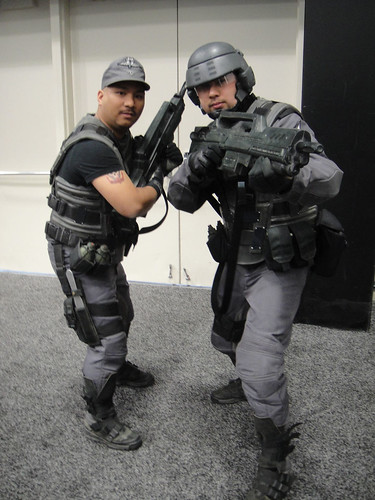
Starship Troopers - Flickr / PopCultureGeek.com

Introduction

For some reason, Hollywood has not done justice to warfare in science fiction. Science fiction writers in general do not do justice to warfare in the future. Most of the science fiction out there uses technology that is backward by today's standards. One of the best exceptions to this rule would be space operas like "Star Wars." Another exception would be intense world building books like "Dune" which uses military conflict only to as an aspect of building the fantastically strange culture within it.
 
Basically, the situation sucks in science fiction though. About the only thing that is done right is the fact that a grunt still has to go out and hold ground. It is about human courage and perseverence that carries the fight and the day. As humans we are typically outgunned to boot so we need all the firepower we can get, so this document will try to set the record straight.
 
This work will be broken up into three parts. The first part will be a listing of technology available to several types of science fiction infantry and conventional U.S. Marines of the 1990s. A discussion of the comparative effectiveness of the various types of infantry presented will then be done. The third part will cover what the military in the United States is trying to develop for the twenty-first century. The technology of the future battlefield will also be discussed, and the key point is about how lethal the environment will be.

Science Fiction Infantry Compared

Science fiction infantry covers a massive spectrum. For the purposes of this discussion, only 3 near future types of infantry will be covered. They are troop types that are identifiable to us, and are more easily dealt with due to their similarity to our current concept of a soldier.
 

Starship Troopers - The Book by Robert A. Heinlein

Heinlein was the first to portray powered infantry. "Powered" means infantry using armoured exoskeletons that are power/hydraulically assisted to enhance the strength of the soldier. This is the most powerful type of infantry to be discussed in this paper. These are highly trained, elite infantrymen who are the equivalent of today's elite troops like marines or paratroops.
 
Infantry Weapons/Armour
  • Powered Armour Suit "you look like a big steel gorilla, armed with gorilla sized weapons."
    2000 lbs of steel forged to make a sealed NBC and vacuum protected environment.
  • Suit enhances the natural strength of a trooper and and easily crush a gorilla.
  • Suits can be controlled so a trooper can pick up an egg without breaking it.
  • Suits are worn like a second skin so it is natural and subconscious to use it.
  • Has ability to move fast in low bounds by leaping. Can leap onto low buildings.
  • Has rocket assisted takeoff and landing for longer/higher leaps and landings.
  • Has hand and heavy flamers - a heavy duty laser continuous beam laser weapon.
  • Have back-mounted automated bomb launchers.
  • Decoy grenades and real grenades.
  • Troopers have a high explosive or nuclear rocket launcher.

Communications Gear
  • Helmet mounted radios - at least 3 audio circuits.
Sensory Enhancement Gear
  • IR Snoopers
  • Rangefinders - probably laser.
  • Audio enhancers.
  • Radar mappers to see platoon dispositions and map.
  • Homing beacon locator.

Other Gear
  • On-board recycling system for air and human wastes, built-in thermal signature suppresion, medication injectors, water nipples, nutrient dispensers.
  • Gyro-stabilized suits.
  • Built-in diagnostics in the suits, can be remote monitored by platoon leader.
  • Self-sealing.
  • Lights 
Squad Organization
  • Squad leader - sargeant in command suit.
  • 9 grunts - in marauder suits.

NOTES: Are command, marauder, and scout suits. There is a special weapons squad.

Starship Troopers - The Movie

Infantry Weapons/Armour
  • Morita Smartrifle - conventional design, has a high magazine capacity (more than 30 rounds the way they fired in the movie - but it is hard to believe they could have had more considering it fires a 7.62 mm cased round and the small size of the magazines). Fires at 600 rpm. Seems to have a undermounted pump shotgun.
  • MX-90 hand grenade.
  • Tactical Nuke Launcher that fires the MN3 tactical nuclear warhead with smart guidance.
  • M3 tactical helmet.
  • Some kind of vest - probably ballistic cloth.
Communications Gear
  • Beltcom on belt
  • Com backpack
Sensory Enhancement Gear
  • Some night vision scopes and telescopic sights
  • Electronic binoculars.
Other Gear
  • Bayonet
Squad organization
  • Squad leader - armed with rifle.
  • 9 grunts - 1 rocket launcher, all armed with rifles.

NOTES: Have access to heavy machineguns.  Assault craft have some kind of energy cannon or mortar.


Colonial Marines From The Aliens Movie

Infantry Weapons/Armour
  • M-41A Pulse Rifle - bullpup rifle design, 99 round magazine, 10 mm HEAP caseless round has an integral undermounted pump action grenade launcher with 5 rounds. Fires on full auto around 600 rpm.
  • Smartguns - light machineguns that are semi-autonomous in targeting, enhancing the gunner, large magazine capacities.
  • Pistols - a mix of various calibers and magazine capacities
  • Shotguns.
  • Flame throwers.
  • Chest plates made of alloy for front and back protection.
  • Armoured boots + alloy greaves.
  • Helmets
Communications Gear
  • Helmet mounted radios
  • Helmet mounted cameras to show squad leader what the squad sees.
Sensory Enhancement Gear
  • Infra-red vision enhancers
  • Electronic binoculars
Other Gear
  • Motion Trackers
  • Homers
Squad organization
  • Lieutenant commands a squad
  • 1 squad leader - sargeant
  • 2 fire teams of 4. 1 smart gun, 1 flamer, 2 riflemen in each. 
NOTES: Have heavy machine guns - that can be operated as remotes with 1000 round magazines. and armoured personnel carriers with heavy weapons (light cannon?). Can call in tactical nuclear strikes from space, or nerve gas. Marines are dropped in within an APC from a dropship (crew 2) that is armed with guns, and rockets/missles. Lieutenant stays in the APC to monitor the vital signs of the troopers, checking maps, and giving guidance to his men.
 

Conventional US Marines of the late 1990s

Infantry Weapons/Armour
  • M-16A2 assault rifle - conventional design, 30 round magazine, 5.56 mm jacketed SS109 ball ammo. Semi-auto and 3 round burst capability.
  • M-203 grenade launcher mounted underneath an M16. Fires a variety of 40mm grenades including shot shell, HE, HEAP, Smoke.
  • M249 Squad automatic weapon - light machinegun, 5.56 mm ammo, 200 round ammo box, and take M16 ammo magazines.
  • AT4 Rocket launcher - Anti-tank rocket.
  • Variety of hand grenades including M49 high explosive.
  • Beretta M9 - 9mm semi-automatic pistol, 15 round magazine.
  • Flack jackets
  • Kevlar helmet
  • Claymore mines
Communications Gear
  • Backpack radios
  • Flares
  • Smoke grenades 
Sensory Enhancement Gear
  • LI goggles
  • Thermal sights for rifle
  • Telescopic sights for rifle
  • Binoculars
Other Gear
  • GPS
  • NBC gear
  • Bayonet
  • Entrenching tool
Squad Organization
  • 1 Squad leader - sargeant
  • 2 fire teams - 1 rifleman/grenadier, 1 SAW gunner, 2 riflemen each.
NOTES: Squads have access to call in heavier weapons such as heavy machineguns, SMAW bunker busting rocket launcher teams, anti-tank missle teams, automatic grenade launchers, anti-aircaft missle teams, and mortars. Close air-support is also a big bonus, along being able to call in fire missions from field artillery. In addition the marines have tanks and armour personnel carriers with a variety of weapons ranging from machine guns, light cannon, and heavy cannon.

Discussion of the the Troop Types

The troop types presented above show some typical science fiction and conventional late-20th century infantry. From a firepower perspective the Starship Troopers from Heinlein's novel are miniature tanks easily capable of taking on a platoons of the other types of soldier presented. The power-suited troopers are fast, mobile, and coordinated with devastating firepower at their disposal. The next most powerful troops would the the Colonial Marines from Aliens. These tough hombres pack a reasonable facsimile of near future firepower, but still falls short of the potential firepower available to the 21st century soldier. Their large magazine capacity rifles with integral grenade launchers, sensor gear, and smart guns give them an edge in fire power over 20th century troops. The late 20th century marine troops have the next most available firepower with the soldiers in the Starship Troopers movie being the most badly undergunned. It is no wonder the soldiers in Starship Troopers got annihilated as they couldn't bring enough firepower to bear against attacking bugs. The use of nukes by lightly protected infantry is also pretty bad and it reminds me of a cartoon I once saw where a puzzled soldier tries to figure out how to throw a nuclear hand grenade far enough away when it has a lethal radius of a kilometre. This ranking of the troop types would also apply if they fought against each other, with the Colonial Marines and the current day marines being fairly on par.
 
Against waves of enemies charging across open ground the Heinlein Starship Troopers of the novel would be able to maneuver and fire an amazing amount of firepower. They would be able to use nuclear weapons at much closer ranges than the other troop types, have high-energy weapons capable burning swaths of enemies. To clear out an area near them they can also auto-dispense bombs to buy breathing space, not to mention jump out. The Colonial Marines would make a good showing, especially with the heavy weapons on the the APC and close air support from the drop ship. These marines could put out a lot of lead in short order. The current day marines would have slightly less personal firepower, and would have access to as-lethal close air-support, armour support, and artillery. The Starship Troopers in the movie seemed to be badly undergunned and on their own.
 
In close quarters the Heinlein Starship Troopers of the novel would be at an increased disadvantage as their superior firepower and mobility would be limited. They would be unable to get the full potential from their battle suits or use the big weapons as they could collapse buildings on themselves or hit each other. The other types of troops would be at a lesser disadvantage as their personal firepower is still mainly a bullet firing gun and their mobility and cover is at a maximum.
 

The Twenty-first Century Soldier and His Battlefield

The battlefield of the 21st century is going to be a very lethal one. The introduction of computers into all weapon components, making "smart weapons", will make life short and deadly on the receiving end. Very few science fiction settings present technology that is close to what the near future will likely hold in store for us.
 
The typical gear of the 21st century infantryman will be a head to toe sealed combat environment suit of armour plates and kevlar. This suit will have built in environmental control (to handle conditions from the arctic to the tropics), IR signature suppression, be sealed against chemical and biological weapons, and offer at least some full body protection from bullets/shrapnel/mines. The soldier will have a tactical helmet with a map display, built-in radio link, GPS positioning from satellite, with enhanced hearing, and night vision gear. The rifle will still be the standard weapon with a high capacity magazine firing high velocity caseless ammunition with telescopic sights and laser range finder. Both the range finder and telescopic sight can transmit data from the weapon to the soldiers helmet and to headquarters. An integral grenade/mini-rocket launcher will be part of the rifle. The grenades/mini-rockets will be possibly be smart enough so a soldier will be able to laser designate a target and have the grenade fly right at it with pinpoint accuracy or even detonate a meter behind it to get any soldiers using the wall for cover. In addition, the soldiers will have backpack mounted smart missles that are fire and forget to destroy larger targets like tanks and bunkers. Large armoured vehicles in this environment are very vulnerable and need lots of point-defence protection from smart artillery rounds, and missles to avoid obsolescence. Smaller robot tanks that have AI or are remotely operated may have a better chance at surviving. An infantryman in this environment may have a better chance at survival as they are more stealthy, but would be rapidly finished off if spotted and enough firepower is brought to bear. The infantry will now be more dispersed for survival and their biggest problem is still one of mobility, something that will still require a solution. Officers will also have more information on the exact position of their soldiers, be able to see what they see, and have unprecedented command and control abilities on the battlefield.
 

Conclusion

Speculation about the future is speculation. In military technology, you can only assume the battlefield gets more lethal and that combat becomes more intense. The face of combat will change, and may even become obsolete due to technological progress. While men are still involved in fighting, they will always want the best weapons available and blood will be spilled. Let us make sure they are not armed with second rate weapons, especially if they fight an alien menace. This is going to make storytelling a little harder, but storytelling is about creativity.
 

Appendix A. Stupid things involving weaponry in Sci Fi

1. X-File novel "Ruins" - Use of a mortar to level a pyramid of rock. This should only take about a year to do so.
2. Lasers - In general these weapons usually pack a punch, but they sure seem to fire slowly on TV. A submachinegun and a couple of grenades would clean out a pack of Klingons or stormtroopers advancing down a hall in no time. Lasers are almost never properly implemented. If they fire a pulse, it'll be more like a flash - like the pistols from Battlestar Galactica. No one also ever uses a high energy continuous beam - probably useful for slicing and dicing everything.
3. Grenades - Are almost never used in science fiction, but a real infantryman uses them whenever they can to clear a room, knock out a strongpoint, etc.
4. Carebears wiping out the Emperor's crack legion in "Return of the Jedi". How does a miniature bow with a stone arrowhead penetrate hard body armour?
5. Starship boardings - Use directional mines such as claymores to fill the whole corridor with lethal shrapnel. Guaranteed to stop pirates or navy boarding teams.