Tuesday, 29 September 2015

Ghost Fleet Review

Mini-review #18

This is a series of short reviews for military SF and mecha SF.  You will not see a review of something I don't like as it isn't worth writing about in that case, but I will tell you what works for me and what doesn't about the stories I did like. 
Back in June and July this year, there was suddenly a wave of reviews and some press coverage for the novels Ghost Fleet and Tin Men. Both involve near future extrapolations of current military technology and they are scifi-ish technothrillers.  I will say that both novels use future tech in a way that puts a great deal of military SF to shame as they are more advanced in concept than some other writing.  I went onto the waiting list at my public library to get this book as I don't buy hardcover fiction and the ebook was awful expensive.  So 2 months later, I can now review it!

Ghost Fleet in particular is very good at the showing the implications of future tech and the battlespaces in which it operates.  I really liked it and it sure didn't hurt that it had a good story behind it as well.  Some reviewers have compared it to Tom Clancy's Red Storm Rising for the 21st century so far and I would pretty much agree with them.

The basis of the book is about a Pearl Harbor 2.0 event for the Americans, who are attacked by China this time (since they're the new Soviets since the end of the Cold War).  The Chinese and American perspectives are nicely done and the conflict rages across the Pacific on the surface, in the air, on the ground in Hawaii, and even in space.  The American technological advantage in this case works against them as their electronics have component manufactured in China and have been compromised (this was something that was used in David Gerrold's novel, The War Against the Chtorr decades ago).  A bit of space war against US military satellites, and extensive cyber warfare neutralizes American military power for awhile.

One littoral combat ship escapes from Pearl Harbor and the XO, Jamie Simmons, becomes captain the USS Zumwalt from the Ghost Fleet of mothballed ships in California.  The Zumwalt is outfitted as a railgun ship, but everything is experimental on board.  So there is plenty of surface action and plenty of engineering work to do below decks (where's Scotty when you need him?).  Anyways, without giving any more away, the book is a great read.

Does it have a cast of characters listing?
Nope.  But there are Russian spies, plenty of admirals on both side of the Pacific, eccentric billionaires who want to help the war effort, hackers, and of course, the crew of the Zumwalt.  Jamie Simmons is a man who is conflicted, but learns to become a great captain with the help of his father, who is also assigned to his ship. The two start with a bad relationship that develops in other directions over the course of the novel, adding some good elements to the story.

What is the scope / scale of the story?
Ship to ship action, fleet actions with plenty of missiles in the air, naval bombardment, guerrilla action in Hawaii, and even a murder mystery plot all spice things up.  There are some good sections set in space and I'll just leave it at that.

Does it have likeable characters?
You care about a number of the characters, but I found myself liking the Chinese lady engineer on the Zumwalt, Jamie's father, and all of the named Russian characters.  The Chinese Generals and Admirals were pretty flat characters, but they move the story along.

Does it have an entertaining story line?
Very entertaining.  I finished the book in one long read.  There are multiple groups of characters and they all get some good screen time so to speak.

How is the internal consistency / plausibility?
Wow, this one is a no brainer.  I think the authors nailed a pretty good vision of the future high-tech battlefield and all of its implications.  It is very well done and plausible.  China's reason for war is that is needs room to grow and it needs to remove the American obstacle.  The politics were fairly good, but it seems like all of Americas allies abandon her when she needs help the most (Fortress America mentality) and I'm not sure that would really happen since they were the victim of a massive surprise attack. The conflict doesn't go nuclear either, but that would make for a short book.

What cool bonus features are there?
Little tiny lobster recon / multi-role bots.  Extensive use of drones of all sizes.  Railguns that work. Old tech vs new tech.  Old retired veterans showing young pup sailors how to do their jobs right even if they have all that cool knowledge for the new tech systems and use "Viz" the next gen Google Glass. Plenty of scary mind manipulation and common use of stims for soldiers too.  The F-35 showing that it works when its systems aren't compromised (I don't like the plane much myself, but boy has it been getting bad press these days).

Sunday, 20 September 2015

Review of Tin Men by Christoper Golden

Mini-review #17

This is a series of short reviews for military SF and mecha SF.  You will not see a review of something I don't like as it isn't worth writing about in that case, but I will tell you what works for me and what doesn't about the stories I did like. 


This book was a pretty enjoyable read, but it almost threw me off at the start.  The premise of the novel has America being the global peacekeeper in the near future because of they have the Remote Infantry Corps, a war winning technology that no one else has.  These Remote Infantry Corps ("Tin Men") are armies of remotely operated humanoid robots (human sized) that are extremely strong, extremely tough, and are faster and more dexterous than an actual human.   An American operator basically controls the robot as their surrogate body (like they were in it - aka the Avatar movie) from a base in Germany to any point in the world.  This whole peacekeeping aspect (which is a good thing in many ways) and American dominance via tech almost made me stop reading (it was pretty high handed), but it is an integral part of the story in making the Tin Men hated by many enemies around the globe.  As the story progresses, something terrible disrupts the entire world and you see the soldiers as human beings and really hope they get out of their fix as they are trapped operating the robots.  I recommend this book as a good read.

Does it have a cast of characters listing?
No.  It basically operates at a platoon level with three sets of protagonists.  One being the soldiers originally in the Middle East, another being the President of the United States and this protection detail, and the base troops for the Tin Men in Germany. 

What is the scope / scale of the story?
Street level combat with squads and platoons within wider battles around the globe.  A murky, unknown force is behind the disruption of the world.

Does it have likeable characters?
PFC Danny Kelso is the main protagonist and you like the guy and quite likable.  I like the fact that there are male and female soldiers in the field and you really want them to find a way out of their situation.

Does it have an entertaining story line?
Yes.  The story line moves quickly and shifts between the multiple groups of characters.  There are good survival, journey, and political sub-plots to the book.  Having some civilians mixed into the Tin Men as they journey across a devastated world was a good touch.

How is the internal consistency / plausibility?
Hmmm, this one is tough one.  The tech is internally consistent in the book and it works for the story - I enjoyed the story even if I didn't think the tech was plausible.  I'd have to say the plausibility is a no, based on the level of tech that would exist to support the Tin Men (it is near future).  SPOILER WARNING : **** The plausibility of transferring a consciousness to an artificial brain via a high speed satellite link is a big no. ****  The robots are also extremely tough.  Something humanoid size wouldn't be resistant to .50 or grenade launchers to the level they are in the book, but they are feared because of this.

What cool bonus features are there?
The whole concept of remotely operated infantry robots is pretty cool.  Since combat is always about getting down and dirty, this is a nice extrapolation from our current drone operators. 

Edmonton Eats in the Summer

Over the past half year I've done a bit of food consumption in the city.  Edmonton always has plenty of good eats both fancy and simple.  Now I just have to get cracking on the writing which isn't so simple!  But, here is a batch of tasty food pics for now!

We had some very nice weather earlier in the year and it was pretty nice to have breakfast on the deck.  Waffle, strawberries, and bacon!
Fish Tacos from State and Main down at Southgate Mall.  Very tasty and they have a nice patio to sit on when the weather is good!
Steak, mashed potatoes, asparagus and a fresh tomato salad on the deck again.  Yum!
Wendy's had a pretty nice strawberry chicken salad they offered as a summer special.  It didn't last all summer, but it was pretty good while it lasted.
Wendy's strawberry salad up close.
Chorizo breakfast bowl with scrambled egges, tomatoes, cheese, etc., from Ricky's.
We went for a special pork breakfast one morning down at Zinc, the restaurant in the Art Gallery of Alberta.  The food there was pretty good usually and this breakfast was different.
Art Gallery of Alberta
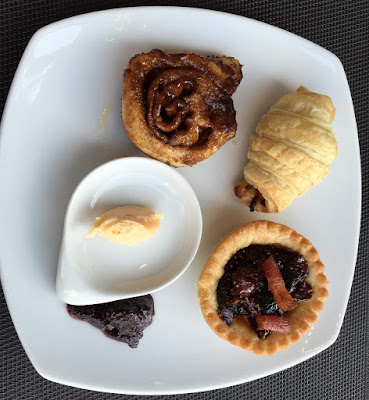
It started with some pastries and tarts all featuring bacon. 
Then there was the main part of breakfast with beans, side meat, and a nicely done egg.  This was pretty rich and the serving was generous.  We ended up taking some home for tasty leftovers.
Dessert was a creme brulee with chocolate covered bacon.  Was crispy and yummy!

Another time, we headed out to the Hardware Grill for dinner.  Had a nice meal there.
Smoked salmon appetizer.  Very good.
A tasty rack of lamb and more.

Switching restaurants to Famoso, here is their Capriciossa Neopolitan pizza.  Italian ham, roasted mushrooms, artichoke hearts, olives, and romano cheese. One of my faves.  

That's a fair number of pics already, so I guess I'll do another post a little later for the rest.

Saturday, 11 July 2015

Price Drop on Neo Ace and Summer Sci Fi News

UPDATE: The price drop period was only from July 11, 2015 to the end of September 2015. 
I recently dropped the price on my novel Neo Ace to 99 cents US$.  If you're interested in a good a good read, hit the link and head over to Amazon.  I'm also looking for some reviews and if you liked it, please leave one and help me out.

It has been a pretty busy summer and work is finally starting to slow down a bit.  I'm still plugging away slowly at the concluding novel for Exocrisis Blue.  When I get a few chapters done, I'll start posting it up on Wattpad again.  Neo Ace is a complete story arc as I wouldn't want to leave anyone hanging (I hate it when it happens to me), so no worries if you want to read Neo Ace.

Edmonton City Hall, or life under the dome if this were an offworld colony.
So far, this year has been pretty good for my own science fiction enjoyment.  I'm not reading nearly as much as I should, but the mix of anime, sf novels, movies, and comics has been pretty good.
  • As I'm a Canadian, eh, one item of interest that has stood out is the mini-series comic "We Stand On Guard" from Image Comics.  This is written by Brian K. Vaughan, an American married to a Canadian and is about a future war between America and Canada.  Canada has basically been overrun by American mechs and we're fighting a guerilla war.  In most scenarios we'd be hamburger if attacked by the States, but the first issue was pretty entertaining and I'm interested in the rest.
    http://www.cbc.ca/m/news/arts/we-stand-on-guard-comic-offers-explosive-look-at-canada-u-s-relations-1.3137480http://kotaku.com/one-of-comics-best-writers-has-america-and-canada-figh-1716016922
  • The Gate (can be seen on Crunchyroll for free legal streaming).  This is about a gate opening up in Tokyo's Ginza that disgorges a fantasy army of goblins, roman-like legionnaires, and flying dragons.  The JSDF fights them off, and an otaku army officer helps to save the day.  The JSDF invades the other world to secure the gate and has to immediately defeat another massive army of medieval low tech types.  Our hero, the otaku (and the JSDF has tried to appeal to them via recruiting campaigns) is now in his dream universe and trying to establish relations with the locals while holding the evil empire at bay.  https://en.wikipedia.org/wiki/Gate_%28novel_series%29
  • The movie Chappie, Jupiter Descending, Interstellar, Avengers: Age of Ultron, and Jurassic World, etc. Have all been pretty good.  Jupiter Descending was kind of lambasted, but I think it is better than some simply because it is a good story (especially when compared to most comics or TV SF) with an original idea.  Jurassic World was just fun, and yes, what kind of moron would weaponize raptors?  Chappie became a movie with ideas far bigger than the movie in a hurry, but it was enjoyable too.  Interstellar had a terrible storyline (probably easier to spend that space program money to genetically engineer something that actively resists or kills the blight), but the ideas about space and time in it were all top notch.  Avengers was an awesome superhero movie, not as good as the first one, but it was nice to see some character development for Black Widow, etc.
  • I just finished Leviathan Wakes from the Expanse by James Corey and am reading the second book.  I wanted to read this as they were making a TV series based on this.  It was an enjoyable space opera kind of read with many factions from the belt colonies, Earth, and Mars, plus the obligatory evil megacorporations.  The one thing I did find really funny about it was the fact that food was mentioned quite a bit in the book, but I did find it inadequately addressed.  In a previous post, I talked about the SF future of food, and my observations stand on this.  The book always talked about the food being bad.  This situation only could occur if you were in a survival situation or had strict central bad planning over food.  The Expanse universe is clearly not any of these situations. 
    Food is easy to grow and it will be tasty simply because food science is already here to deliver it.  People will also demand tasty food.  With the hundreds of millions of people in space, I would have actually expected Martian, Jovian, and Belter cuisine to have evolved that had its own distinct flavourings and styles that had diverged from their earthly origins.  Like airplane food is prepared for low pressure and the dry climate found on planes now.  Nothing like a spicy belter roll for zero G with the Jovian moonbugs that pop in your mouth. Also, energy should be cheap with massive solar arrays (continental size in the asteroid belt) or fusion, etc.  But energy was not cheap back when the book was written and scarcity still pervades the work.  Still, a good read, with a crazy and powerful unknown threat in the background.
 Anyhow, those were just a few of ramblings, so have a great summer everyone.

Sunday, 10 May 2015

Sci Fi Railguns, Lasers, Drones, Energy, and Food

I haven't posted for awhile, but I'm still reading and writing.  I'm about to set a new deadline of a year for my next novel again.  It has been about a year since I completely went off track on my fiction writing due to the random nature of life (sometimes you just roll snake eyes).  Anyhow, the big news here in Alberta is that hell froze over after the left leaning NDP won the provincial elections against the conservatives this May as it snowed the next day.  The NDP had about half the support of the voters, mine included this time, and they are kind of left of center party, but almost all Canadian parties would still be classified as centrist/socialist even if they are right or left wing.
Gundam Pods from a Japanese Arcade, but imagine banks of these things with pilots flying attack drones or a squadron of drones.
Going back through my various news feeds, there has been a number of interesting articles that have popped up.  From some of my previous posts you can tell that I think the science fictional future of a great deal of military SF is pretty near future.  Basically, a great deal of the mechanisms, and plot devices that authors use now are going to look really dated as they are obsolete already if they occur in any kind of timeline derived from our present.

A long time ago (back in 2000) I wrote an article about Science Fiction Infantry Warfare.  Most SF writers haven't advanced much beyond the marines from the 1990s described here.  If we're lucky they are wearing enclosed combat / powered armour.  However, experimental exoskeletons and improved body armour and weaponry are both in the lab and being field tested today so future soldiers are going to be more like Heinlein's mobile infantry than anything else.

A few links about some of the tech involved:

So here are some of my characteristics of a near future infantryman.  I expect the infantryman in a heavy assault configuration to be pretty darn tough after they are suited up.  In the far future - infantrymen could be completely obsolete or even tougher.
  • Wears a powered exoskeleton that runs all day on the move to double the weight the soldier can carry at a run.  A soldier can lope at a powered run faster than  a man can run for an extended period.
  • Soldier has head to toe protection from small rounds - impervious to 9mm pistol fire and wears nano-weave armour with ceramic plating to stop rifle rounds.
  • Suit is climate controlled for tropics to arctic with the right environmental modules and sealed from gases or toxins with filtered air.
  • It is a smart suit that will administer stimulants or antidotes if necessary to keep a soldier functioning.  Possibly the nano-weave can contract to tourniquet a limb wound, or offer self-sealing capabilities.
  • Suit is a chameleon suit that can blend into the background and be thermally camouflaged for a short period of time.
  • A soldier will have a 360 degree view in his helmet for high-situational awareness with thermal, low light, telescopic, and superior hearing / shotgun mike capabilities.  This system will integrate with his weapon sights to designate targets and smart-track them.  Mapping capabilities with drone / squad mates / live data feeds will vastly reduce the fog of war.  
  • Will carry a smart rifle and grenade launcher.  Smart rifle will auto range and adjust for windage to have a high percentage hit capability at 500 to 1000 metres especially with steerable bullets.  Semi-auto grenade launcher with sub-40mm rounds that are guided and smart fuzed to engage defiliaded targets.  The exoskeleton allows for a heavier weapon and larger magazine capacity for these weapons.
  • Possibility of railgun / coilgun type weapon firing either small or large penetrators and hundreds of light weight projectiles.
  • Will be able to carry grenade-size rolling ball robots for recon down hallways or rooms.  Will have several toss and fly type drones to scout ahead.
  • Suit can be configured to carry anti-tank weaponry or heavy anti-material rifles that link into the suit's helmet for targeting.
All that sounds futuristic, but if I think far future, I'm thinking that this is obsolete and the infantryman would be even deadlier, more nimble, and lighter in weight too. I'd be thinking unlimited ammunition, energy weapons, a cloud of nano-bots to protect, jam, hurt enemy combatants, robotic support units, ultralight powered suit with some type of shielding, and smart AI to control all this stuff.  It would be a one man army.  Then there could be the augmented human body aspect too.

After talking about infantry, lets talk about the air force and navy.  There will be no more manned fighters as survival in an environment with drones and lasers is too low.  Manned fighters would also be like a magnitude of order more expensive to build and wouldn't maneuver was well as a drone.  Aircraft carriers are impressive platforms to project air power, but they are also expensive and high-value targets to sink.  If you are trying to protect your high-value asset you are probably not getting the maximum use out of it as you will not put it into risky situations or are diverting too many of your forces to protect it.  Laser weapons as anti-missile defences also seem to be making big advances too along with railguns for lobbing projectiles to do bombardment.

A few links on this topic:
In my writing, I think of drone carriers, but they are smaller vessels that can mass launch attack drones via a vertical launch system and do a trap and recover on a small deck, or they are like stealthy flying airships that have drop bays to mass launch attack drones.  I already use coilguns for my HARM units main weaponry, and I don't have manned fighter aircraft so I'm already ahead in the few items of military SF I've written.

Finally, today, let's talk about food and energy!  Food is something that isn't imagined too well in SF.  Protein bars, ham sandwiches, and odd colored fruit.  What is the next exotic breakthrough or food concoction?  Just think about the impact of new world crops like potatoes, avocados, tomatoes, corn (as in maize), chocolate, etc., on the world.  There was no tomato sauce in Italy.  Greek salad with tomatoes didn't exist.  Avocado sushi wouldn't be around.   No french fries or chocolate cake either.
So what kind of food innovation, next great crop, or types of food stuffs will exist in the future.  What is the next big thing to replace a hamburger or pizza and will it be of earthly origin?  Will we eat meat or think it is barbaric?  Will we all eat healthy to boot?

Energy is going to be cheap and renewable.  There will be a distributed grid and every building will have its own batteries and solar panels / vertical wind turbines.  It is just a matter of decade(s?) for this to happen now.  Remember, this is the now, not the future, and you never can get the genie back into the bottle after letting it out.  We'll have super-batteries and ultra-efficient solar, with energy possibly being beamed down from space-based arrays.
Everyone have a great day, this post turned out far longer than I expected.

More SF Posts


Sunday, 15 March 2015

Beaming Solar Energy to Earth

Solar energy is only on when the sun is up or efficient when it isn't cloudy or the collectors are covered in sand or snow.  To solve this problem, there was the idea of putting solar collectors into space.
This is an interesting little picture I shot of a partial eclipse in Edmonton in late 2014.  The lens flare is the cool part as it shows the partial sun.  I was using a pin-hole camera to view the eclipse rather than go blind staring at the sun myself.
These big space arrays would be in geostationary orbit above the earth and beam down the collected solar energy in the form of microwaves to collector pads.  This method would have the power always on as they are always in the sun and the energy is sent to earth continuously. 24 x 7.  Bad weather, sand storms, don't affect it either.  Sounds pretty darn good, but then I thought, what if the beam goes off course and you have a big microwave beam gun cooking huge swaths of the earth in its path?  Well, it turns out I have nothing to fear if they are using low frequency microwaves as the output is so low.  You wouldn't want to live there under the beam, but no streamers of birds or bugs like at some solar facilities.  It is an interesting idea and here are a couple of articles about it.


Saturday, 28 February 2015

Current AI Trends and News About the Coming Revolution

Manga Iron Man Figure

Artificial Intelligence seems to be one of those underplayed elements in science fiction.  There also seems to be a great deal of recent general interest in this topic.  AI is one of those inventions that is making  a great many people nervous from Elon Musk to Stephen Hawking too.  Just recently, I read some real long blog posts (there first two links below could be a book - exaggeration here, but it was long) about artificial intelligence.


I majored in computer science years ago, but there really wasn't anything like this way back then.  So artificial intelligence can be categorized as:
  • artificial narrow intelligence
  • artificial general intelligence
  • artificial super intelligence
Our world today has plenty of artificial narrow intelligence now.  Just look at Amazon's recommendation engine, Google's search engine, etc.  There are even expert AI's in specific areas of manufacturing, science, and medicine.  It is interesting that even this level of AI doesn't seem to exist in most science fiction.  The present is more advanced than a great deal of SF.  AI just doesn't seem to exist, but in a sufficiently advanced culture, maybe it just works and blends into the background.

Artificial general intelligence is when AI's are basically smart like people.  AI just isn't here yet, and might not get to this stage for awhile. Artificial super intelligence is basically an AI that is waaay smarter than us and can make itself even smarter.  This is probably where AIs should exist in most SF, but don't exist at all usually.  It is kind of interesting that there is this blind spot in many ways.  Too advanced for story telling?  The Star Carrier books actually have a super smart AI that lives on the moon, which was a nice touch.  And of course, the people don't know if they should trust it, but it seems to be good...

Myself, I worry about AI.  Not necessarily even the super AIs, but just the impact of robotics and AI on society.  The world is going to change, and we can see it coming, but who knows where it will take us.  I kind of suspect it will be a combination of new laws to govern the use of robots in the workplace and society adjusting to how robots are used in the workforce.  Jobs are never going to be the same once a tipping point is reached for both blue and white collar.  I'm hoping for a good future, but I can definitely understand the Skynet scenario too at one extreme of things.

Anyhow, have a great read of the articles.  Fascinating reading.


Sunday, 26 October 2014

The Bolo Stories of Keith Laumer and Ogre the Cybertank Wargame

It probably was destiny to eventually write some mecha fiction.  I grew up with Bolo and Ogre, so even without the Japanese mecha influence, the seeds were already there.  From the Japanese perspective, mechas are about humanoid fighting machines with hotshot/hot head pilots fighting against some evil threat.  From the western perspective they are robots who are efficient war machines that fight wars sometimes for justice/survival and sometime for more pragmatic reasons.  The Japanese believe everything has a spirit, but some of that is also found in the Bolos, but not so much for the Ogre!  I've tried to find synergy between these two influences in my Exocrisis stories, but here is a little article about the battlefield robots of my youth.

BOLO!
You have to love the name "Intercontinental Siege Unit," but that is what a large Bolo is capable of.  These enormous, sentient robot tanks were etched into the memory of a couple of generations of western SF fans in the form of print stories, by Keith Laumer, well before any movies or even the term "drone" was used for robot combat units in the 1970s.  Armed with Hellbore cannons, infinite repeaters, force shields, and thick armour, they have fought on numerous alien worlds to defend humanity.
The stories have held up pretty good with time and I still go back and reread them every so often.  In fact, other authors such as David Weber and many more have just added to the number of Bolo stories over the years.  You would think a stories about robot tanks would be boring as it is about a thinking robot who doesn't have romance, or personality conflicts, or all that human emotional baggage, but the stories are often about people involved with the robots, even if the Bolos are the centerpiece.  These robots act for the honour of the regiment, they are fiercely loyal to their human masters,even when discarded as junk, and they seem to be able to develop friendship with a human commander who is often their pilot.

The stories are now available as ebooks (such as "The Complete Bolo") which is great, as my old copy of Bolo is nicely yellowed now.  Hopefully a new generation of SF fans can enjoy these stories.  Make sure you get the original stories by Keith Laumer first, and not the later Bolo add-on stories to start.  A couple of my favourites are: Relic of War and Combat Unit, but they were all good.  If you've had too much about good, loyal robots then it is time to read the Berserker series by Saberhagen to get some bad robots afterwards.

Ogre, the Wargame
Ogre was Microgame #1 from Metagaming in the 1970s which is now gone.  However, the designer, Steve Jackson bought up the rights and is still producing the game.  I have like a second edition of the game and it is a simple introduction of wargaming with map and cardboard counters.  The game has one player taking the role of an enormous cybernetic tank, while the other player commands a force of conventional armour, infantry, and artillery to stop it.  The game design on this and the followup game GEV are just classic and I doubt it will ever go out of style.
The Ogres were probably influenced by the Bolo stories, especially for the initial artwork, but they are really their own original invention.  It is a niche wargaming franchise with loyal fans, but I don't think many people have heard of it in the last fifteen years or so.  There were multiple expansions for the game, and even miniatures and a crazy Kickstarter to build a giant Ogre Deluxe Box.  I was interested in the edition, but only wanted a box with plastic miniatures, not 3D cardboard standups.  Definitely check out the artist's website below for the original Ogre art.

The World of Exocrisis Blue
More Military SF Reviews
More SF Topics

Monday, 13 October 2014

Using Tokyo as a Model for Edmonton

Edmonton Churchill Square Panorama. Click to enlarge.
Hong Kong, Shanghai, Tokyo.  These are big Asian cities with massive infrastructure projects, and they have that high tech, living in the future vibe.  When describing a future city without dilapidated public transport, amazing architecture, and rich cultural experiences with tradition, modernity, shopping, history, these are all places that have that.  Only Shanghai and Tokyo would have a long history pinned down, but theses cities have been massively redeveloped too.

To write about future cities, their successes, and problems, you need to look at these mega cities.  These cities have their own problems with traffic congestion, overcrowding, poverty, but they also have amazingly glamorous faces that just overwhelm you with massive scale, fun, and interest.  I live in Alberta and travel regularly between Edmonton and Calgary.  Both are mid-sized cities in North America, or teeny tiny cities in China where a middle sized city in the tens of millions.  This means there are many growth potentials and being small makes you nimble to be able to leap frog the big boys.  In our cities, you have space to grow, even if you don't think so.  Both cities have invested in light rail transit (trains are the way to go), upgraded freeways, business development, and the arts.

Tokyo City Hall is huge, but the city is 50 times the size of Edmonton.
The entire building from further out. That big plaza in the first photo is up there are treetop height.
Edmonton City Hall.  Not as big but very nice and more people friendly with the big pool in the summer and the ice rink in the winter.
I created a fun blog post about Edmonton at my Tokyo site here. We do have a great place under the sun.

I watched the film Lost in Translation again after watching it years ago.  After having visited Tokyo I don't know how you couldn't have fun even on your own - you have to be seriously depressed to not have fun like it showed in that movie.  When you travel to these big cities you realize just how much happens in them, and examining their successes in infrastructure development and cultural experiences can only benefit Edmonton and Calgary.

I'm going to focus on a few things for Edmonton.
  • Invest more in the arts scene from art education during K-12, live music, public art, theatre, and art galleries.  This may mean more grants and making cheap real-estate available for art galleries and art studios.  Those horribly underutilized downtown LRT stations with the big empty spaces could become artisanal malls that open year round after facilities improvement and definitely better security.  By artisanal, I mean anything to do with a craft from hand sewn goods, to organic farmed produce, custom bicycles, and any art from painting to computer games.  You cannot direct growth like this as it is typically organic, but once you have critical mass, it is self-sustaining.  The JR East company in Tokyo has developed many spaces under their rail lines into different types of themed malls, and some train stations have markets just for "local" food and products.  The closest equivalents to these are City Centre Mall / Churchill Station and Southgate Mall / Southgate Station.
Outside Shibuya Station at night.  It is busy.
Bullet Trains
Shiodome City Center Building Ground Level With Big Atrium
Looking up from Ground Level at Shiodome City Center
Shiodome walkway (+30 level) underneath a monorail line. The street is below this.
Giant Head at the Bow Tower / Calgary
  • Roofing over Churchill Square would be cool to create a all seasons space.  More mega building projects that attract people and not the monster traffic interchanges we seem to build so they can be seen from orbit.
  • Where is our sky deck or eagle's eye observation gallery to see the city?  
  • What is our city's identity, theme, or slogan.  If we don't have a good one, we're better off with none and not spending a cent.  No PR agencies please (so far the ones for Alberta / Edmonton projects haven't been all that great).  It might be better to wait to see if some of these developments take off build one on our successes.
Some of these things sound kind of science fiction-like, but that is what I write for fun.  I also write about Tokyo over at my Tokyo Excess blog too!  I like Edmonton and I'm not saying it should be Tokyo, but we need to take tips from successful cities and innovate to catch up.  I just hope some of these things happen to make the city a more vibrant place.

Finally, just some thoughts about what the future economy would be like.  We're currently highly dependent on oil and gas for our prosperity.  What happens when alternate energy, especially solar + battery storage takes off?  Price of oil will plummet again, but oil is still used for chemicals and plastics.  Basically, we need to do more final processing in the province of oil into products and not export crude to gain the most value of the the resource.

Chinese and Italian Supermarkets of Edmonton

Edmonton has a bunch of great ethnic supermarkets.  There are Lucky 97 and T&T supermarkets for SE Asian, Japanese, and Chinese foods.  There is the Italian Markets and then a few smaller, but well stocked, Korean stores.  You could be inclined to spend an hour or two in the big ones, and places like T&T and the Italian Market have places you can sit down to have a snack or lunch too.  Places like this add character to any city and to any story or novel you want to write, so don't forget the little details that could make things more interesting. 

In my Neo Ace novel, I have the Alien War displacing a portion of Japanese population to live in Edmonton and many other places in Canada.  Canada accepted refugees and they brought a bit of Japan with them and it fits well into the Canadian landscape.  The book is partially based on anime memes of mecha academies and adolescent pilots, but unlike parent meme, the adults and combat veterans really run the show.

Anyhow, here are a few pictures of the ethnic goodies from these supermarkets.  You could make pasta dishes, curries, and more!  The variety of foods, snacks, and drinks makes ensures you'll be have a good time with your tastebuds afterwards.

Yummy Italian sodas
Olive oil
Pasta
Canned tomatoes
Latte and lunch of pastries
Found this once, but not again.  Was a great soda.
Green tea Kit Kats from Japan
Ramune Soda anyone?
Deluxe Pocky
Miso Soup
Make your own Japanese style curry. Absolute yum!
Wasabi Pocky
Choose your death by chocolate
Hello Kitty!
Deluxe Meiji Melty Kiss Chocoalates.
Fresh crab
Dried squid, chewy, fishy, and leathery.  Like it as it is tasty or run away screaming.
That's all!